
Renewable Energy Systems vs. Centralized Power Grids in Improving Energy Access
Introduction
Access to reliable electricity is a basic necessity for all individuals in society. Electricity powers homes, industries, healthcare systems, transportation networks, technologies, and many more. As worldwide energy demand continues to increase, engineers and policymakers face the challenge of providing affordable, reliable, and sustainable electricity to growing populations. Traditionally, electricity has been supplied through centralized power grids, where large power plants generate and distribute electricity through transmission and distribution networks. However, advances in renewable energy technologies such as solar photovoltaics and wind turbines have created new opportunities for decentralized energy generation. The discussions regarding renewable energy systems and centralized power grids have become increasingly important as nations seek effective methods of improving energy access while addressing environmental concerns. Although centralized power grids remain essential for global electricity distribution, renewable energy systems offer significant advantages in efficiency, flexibility, and sustainability, making them a potentially effective solution for improving energy access.
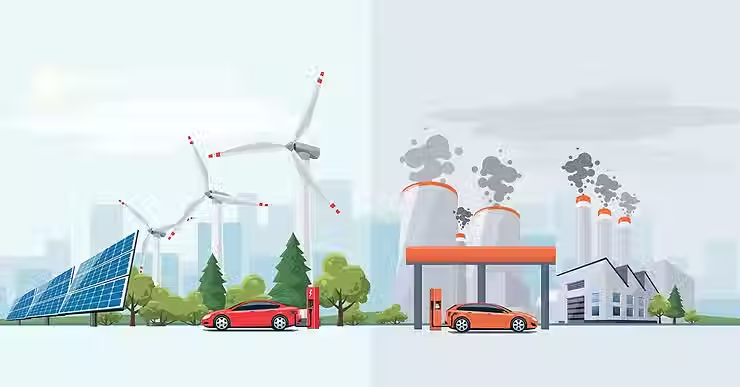
Image Credit: Inspire Clean Energy
Centralized Power Grids
For more than a century, centralized power grids were the foundation of electricity distribution. In a centralized system, electricity is generated at large facilities such as coal-fueled power plants, natural gas plants, hydroelectric dams, and nuclear power stations. These facilities convert different forms of energy into electrical energy through electromagnetic induction, a process described by Faraday’s Law: changing a magnetic field creates an electric voltage in a circuit. Rotating turbines drive generators that produce current, which is then transmitted over long distances through power lines.
One of the biggest advantages of centralized grids is their ability to generate impressive amounts of electricity. Large-scale power plants benefit from this scale, allowing electricity to be produced efficiently and distributed to millions. Centralized systems also provide stable power output because conventional power plants can operate continuously regardless of weather conditions. This reliability has enabled the rapid industrialization and urbanization of many countries.
Despite these advantages, centralized grids also face limitations. Electricity transmitted over long distances undergoes energy losses due to resistance in transmission lines. These losses occur through Joule heating, where electrical energy is converted into thermal energy. The power lost during transmission can be described by the equation:
Ploss = I²R
I represents current, and R represents resistance. Although high-voltage transmission reduces these losses by lowering current, some energy is inevitably dissipated during transport. As transmission distances increase, efficiency decreases, making long-distance electricity delivery less effective.

Image Credit: Yongjiu Electric Group

Renewable Energy Systems
Renewable energy systems differ from centralized grids because electricity is generated from naturally replenished energy sources. Solar photovoltaic systems convert sunlight directly into electricity through the photovoltaic effect (when a material generates an electrical voltage and current when being exposed to light), while wind turbines convert the kinetic energy of moving air into electrical energy. Unlike traditional power plants, renewable systems can be implemented broadly, from rooftop solar panels to solar and wind farms. Solar energy generation is also heavily dependent on semiconductor materials. When photons from sunlight strike a photovoltaic cell, electrons gain energy and move across the semiconductor’s band gap, generating an electric current. The band gap is the amount of energy an electron needs to break free from its atom and move freely to conduct electricity. The size of the band gap determines whether a material acts as a conductor, semiconductor, or insulator. The energy carried by a photon can be described by the equation:
E = hf
h is Planck’s constant, and f is the frequency of the electromagnetic radiation. This process allows solar panels to convert solar energy into electrical energy without combustion or moving gears.
One of the main advantages of renewable energy systems is their ability to generate electricity near areas of energy consumption. Since the electricity does not need to travel long distances, transmission losses are significantly reduced. Renewable energy systems are also highly modular, meaning further capacity can be added as demand increases. Additionally, renewable energy sources produce little to no greenhouse gas emissions during operation, making them more environmentally sustainable compared to fossil fuel-based power generation.
However, renewable energy systems also face challenges. Solar and wind energy are sporadic because their output depends on weather conditions and the time of day. As a result, electricity production may not always meet demand. To address this issue, energy storage technologies such as lithium-ion batteries are increasingly being integrated into renewable energy systems. While storage improves reliability, batteries introduce additional costs and energy losses when charging and discharging.

Comparing Energy Access
When evaluating energy access, several factors must be considered: efficiency, reliability, scalability, and sustainability. Centralized power grids have been highly effective at supplying large populations with reliable electricity. Their ability to generate continuous power makes them valuable for supporting industrial operations and densely populated areas. However, the extensive infrastructure required for efficient transmission and distribution can make grid expansion expensive and time-consuming.
Renewable energy systems offer a different approach. Because electricity can be generated locally, renewable technologies reduce dependence on large transmission networks and minimize transmission losses. Advances in solar panel efficiency, wind turbine design, and battery storage have significantly improved the performance of renewable systems. The declining cost of renewable technologies has also increased their competitiveness compared to standard power generation. Renewable energy systems can improve overall energy efficiency by reducing the distance electricity must travel before use. At the same time, centralized grids continue to provide advantages in terms of stability and large-scale power generation. When comparing and determining which system is superior, researchers should understand and take into account how each system addresses different aspects of energy access.

Image Credit: Stream Marine Training
The Future of Energy Infrastructure
Many researchers believe that future energy systems will combine elements of both centralized and renewable approaches. Advances in grid technology may allow electricity to flow between centralized power plants and renewable energy systems. In these hybrid systems, large power stations can handle electricity demand while renewable energy sources contribute additional generation and reduce dependence on fossil fuels. The integration of renewable energy systems into existing grids may also improve resilience. Distributed energy generation reduces reliance on a small number of facilities, decreasing the risk of widespread outages caused by failures at individual power plants. At the same time, centralized infrastructure continues to provide the capacity necessary to support growing populations and industrial activity. As energy storage technologies continue to improve, renewable systems are expected to become increasingly reliable. Higher-capacity batteries, improved grid management software, and advances in energy forecasting may further enhance the ability of renewable energy sources to meet demand.

Image Credit: NewsBytes
Conclusion
Renewable energy systems and centralized power grids highlight two of many possible approaches to improving energy access. Centralized grids have provided reliable and extensive electricity distribution, enabling development and industrial growth around the world. However, they are limited by transmission losses, infrastructure costs, and environmental concerns associated with fossil-fuel generation. Renewable energy systems offer other important advantages, including reduced transmission losses, greater flexibility, and improved sustainability. Although challenges related to production irregularity and energy storage remain, technological advances continue to improve the performance and reliability of renewable energy sources. As a result, renewable energy systems are becoming increasingly effective at improving energy access. Rather than replacing centralized grids entirely, the most successful future energy infrastructure will likely integrate both approaches, combining the reliability of centralized generation with the efficiency and sustainability of renewable energy systems.

Image Credit: Accelleron

Image Credit: BP
Works Cited
Adrian. (2026, January 28). Differences Between Smart Grids and Traditional Grids. Retrieved June 1, 2026, from Allpcb.com website: https://www.allpcb.com/allelectrohub/differences-between-smart-grids-and-traditional-grids
Electricity explained - U.S. Energy Information Administration (EIA). (2025). Retrieved from Eia.gov website: https://www.eia.gov/energyexplained/electricity/?utm_source=chatgpt.com
IEA. (2024). Access and Affordability – Topics - IEA. Retrieved from IEA website: https://www.iea.org/topics/access-and-affordability
IEA. (2025). Renewables - Energy System. Retrieved from International Energy Agency website: https://www.iea.org/energy-system/renewables
Renewable Energy vs. Fossil Fuels. (2022, March 4). Retrieved from Ampra Energy website: https://ampraenergy.com/renewable-energy-vs-fossil-fuels/
Ritchie, H., Roser, M., & Rosado, P. (2019, September). Energy Access. Retrieved from Our World in Data website: https://ourworldindata.org/energy-access
Rogers, C. W. (2024). Smart grids and renewable energy | Power and Energy | Research Starters | EBSCO Research. Retrieved from EBSCO website: https://www.ebsco.com/research-starters/power-and-energy/smart-grids-and-renewable-energy
US EPA. (2015, August 4). Centralized Generation of Electricity and its Impacts on the Environment. Retrieved from US EPA website: https://www.epa.gov/energy/centralized-generation-electricity-and-its-impacts-environment
What is Renewable Energy? Sources, Examples, Pros, Cons. (2023, December 8). Retrieved from GMS Thailand website: https://www.gmsthailand.com/blog/what-is-renewable-energy/


Comments