
Causes of Deaths in Alzheimer's
Alzheimer's disease causes memory loss and eventually leads to dementia, but when someone has Alzheimer's, what is the actual cause of death? People recognize what Alzheimer's is and its effects on humans, but understanding the relationship between Alzheimer’s disease and death comes to people in different and unfamiliar types of questions. Alzheimer's disease is a progressive disease of the brain in which dementia is one of the most outstanding and noticeable of several symptoms. One significant fact that results from Alzheimer’s disease is that it is one of the top 10 causes of death in American adults, the 5th-leading cause of death among adults over 65, and the 6th-leading cause of death for all adults worldwide.

Alzheimer's disease is one of the most common forms of dementia. Affecting more than 50 million people globally, the disease has sparked a quest to understand and comprehend it and develop effective treatments. The disease was first identified in 1906 by Dr. Alois Alzheimer, who connected one of his patients’ dementia to certain physical abnormalities he found when he observed and analyzed the patient’s brain after her death. However, despite the discovery, the human brain is so intricate, and Alzheimer's itself is so complex that many scientists worldwide are still working to discover the cause and treatment for the disease.
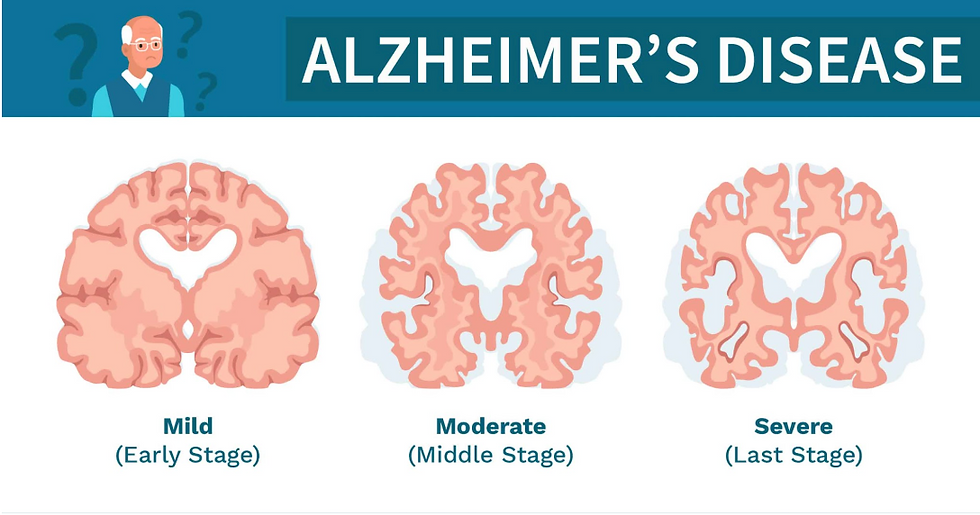
While each case of Alzheimer's is different from each other, there are three stages of how the disease works and influences the human brain, daily lives, leading to death in the advanced stage. In the first stage, little to no cognitive impairment symptoms, including memory loss and confusion, are shown. However, significant changes happen in the human brain, including nerve death, tissue loss, and the buildup of abnormal clumps and tangles of protein.
These changes lead to the second stage of the disease, where symptoms become more pronounced. Patients in the second stage of Alzheimer's disease experience significant memory loss, confusion, impaired reasoning, poor spatial skills, and a loss of language. By the final stage of symptoms, the brain had shrunk dramatically. Patients can no longer communicate, are unable to care for themselves, and have prosopagnosia, including family members and loved ones.
Patients with advanced stages of Alzheimer’s disease need 24-hour supervision and support for personal hygiene, dressing, eating, and other daily activities. Changes in brain function make patients increasingly difficult to move, such as sitting up and even swallowing. These changes lead to complications such as bedsores, skin infections, blood clots, and sepsis, and injuries from falls are common. Difficulty in engaging in daily activities, including swallowing, makes eating and drinking a challenge, and these can lead to weight loss, malnutrition, and dehydration.

The most common cause of death among Alzheimer’s patients is aspiration pneumonia. Most often caused by difficulty swallowing in Alzheimer’s patients, this occurs when people unconsciously inhale food particles, liquid, or even gastric fluids. Our mouths and throats contain numerous bacteria; if unintentional inhalation happens, these are carried deep into the lungs. Then, multiplying and growing lead to pneumonia. Due to the impaired immune systems of Alzheimer's patients, pneumonia is often fatal.

One thing we should remember is that Alzheimer's patients are often elderly and thus have a range of medical conditions that are associated with advancing age. These include strokes, cancer, heart disease, diabetes, and hypertension, any of which can cause and lead to death, whether or not Alzheimer’s is present.
References


Comments